I got a call this week that I've gotten dozens of times before. A homeowner needed a quote to bring their balcony railing up to code — the balusters were spaced too far apart, and California building code requires that gaps in a guardrail cannot exceed 4 inches. A child can fall through anything wider. It's a legitimate safety issue, and fixing it is a straightforward job: new balusters, maybe a new top rail, a few hours of work.
I showed up this morning expecting exactly that. A simple railing upgrade. An hour of measuring, a quick quote, done.
That's not what happened.
---
What I Found When I Looked Past the Paint
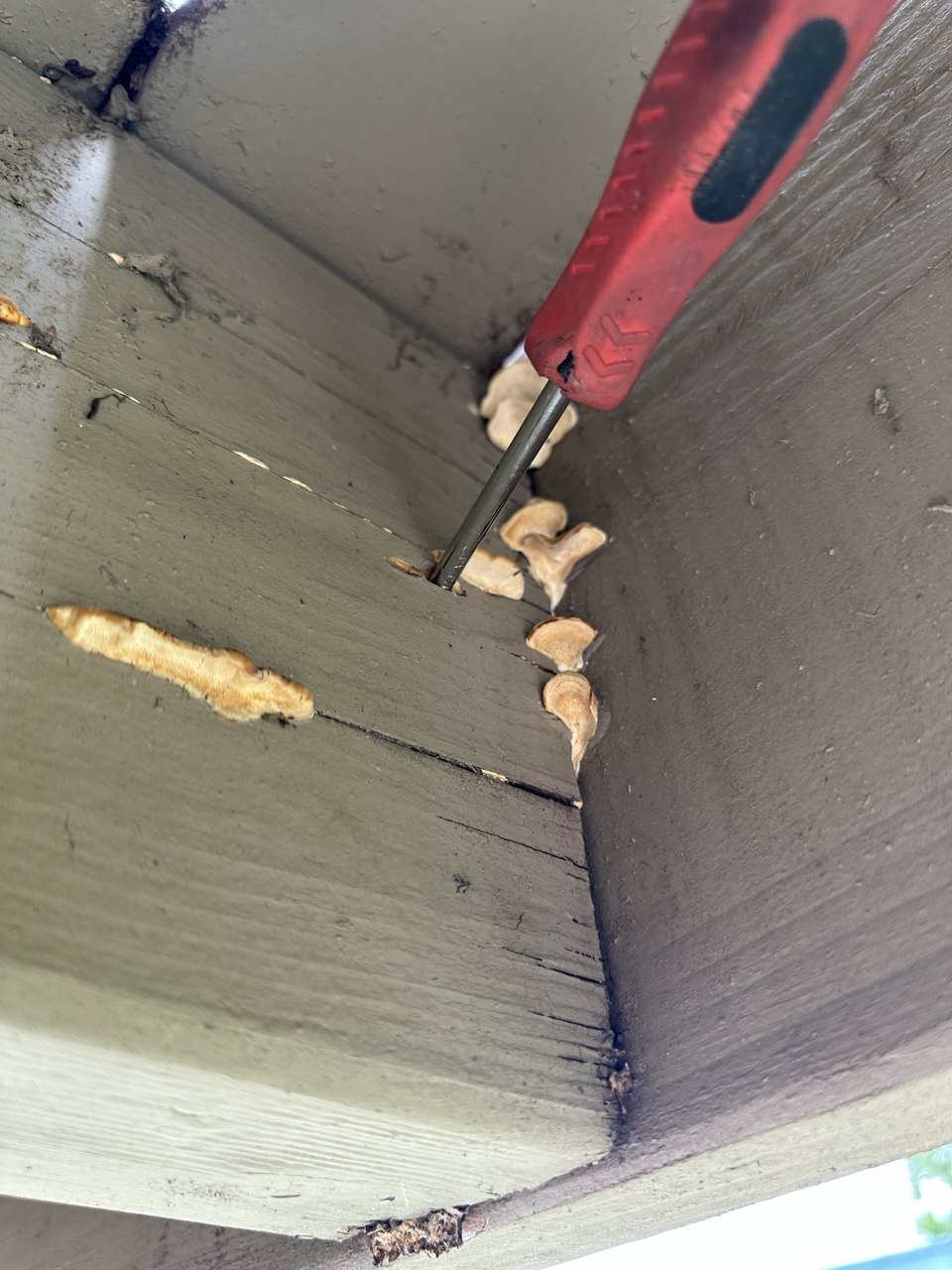
The railing itself was fine structurally — weathered, sure, but solid. The balusters were the problem the homeowner already knew about. I measured the gaps: some were pushing 5.5 inches. Code violation, easy fix. I started poking around the rest of the balcony the way I always do before I write a number down, because you never want to quote part of a job without understanding the whole thing.
I pressed my screwdriver into the end grain of one of the main structural joists — the 6-inch timber beams that carry the entire load of the balcony floor and everyone standing on it.
The screwdriver went in two inches. I didn't push hard. It just went in.
I moved to the next joist. Same thing. Then the one after that. On one of them, I was able to push the screwdriver a full three inches into what should be solid Douglas fir. Three inches into a six-inch beam that's supposed to be holding up people.
The homeowner was standing right there. He'd come out to show me the railing. He watched me do this and his face went through about four different expressions in the span of ten seconds — confusion, disbelief, something that looked like embarrassment, and then something closer to fear.
"I had no idea," he said. And he meant it. He genuinely had no idea.
That's the thing about wood rot. From the outside, a balcony can look completely normal. The paint is intact, the surface boards feel solid underfoot, the railing wiggles a little but that's always been true. What you can't see is what's happening inside the structure — the joists, the ledger board where the balcony connects to the house, the beam ends that are trapped in pockets of concrete or stucco where moisture has been sitting for years.
Fungi eat wood from the inside. They don't leave a sign on the surface until the damage is already severe.
---
The Conversation Nobody Wants to Have
I told him what I found. I told him the railing job was the least of his worries. I told him that the balcony in its current condition was a liability, and that I couldn't in good conscience quote him a railing upgrade and walk away without saying something.
He was quiet for a moment. Then he asked the question I always hear in this situation: "But it's been like this for years and nothing's happened."
Yes. That's how wood rot works. It's slow, it's invisible, and then one day the load — a family gathering, a few people standing in the same spot, a dry year followed by heavy rain — exceeds what's left of the structural capacity, and something happens very fast.
The honest answer I gave him: repair before the accident is always the better outcome. It costs money. It's inconvenient. It wasn't in the budget. But it is infinitely better than the alternative.
I've thought about how to say this without being alarmist, and I've concluded there's no gentle way to frame it. Balcony collapses kill people. They happen in California. They have happened to people who also thought their balcony was fine.
---
Berkeley, 2015
On June 16, 2015, thirteen people were standing on a fifth-floor balcony at the Library Gardens apartment complex in Berkeley, California. They were celebrating a birthday. Most of them were Irish students on J-1 visas, college-aged, home for the summer from Dublin.
The balcony collapsed without warning. Six of them died. Seven were seriously injured, some with permanent disabilities. They fell five stories.
The subsequent investigation found that the structural wood supporting the balcony had been rotting for years. The joists had deteriorated to the point where they retained almost none of their rated load capacity. The balcony had been inspected — and the rot had not been caught, either because the inspection was superficial or because the damage wasn't visible from the surface.
What killed those six people wasn't a sudden catastrophic failure. It was slow, invisible decay that nobody caught in time.
The Berkeley collapse changed California law. It led directly to SB 721, which now requires mandatory inspection of all exterior elevated elements — balconies, decks, stairways, and walkways — on multifamily buildings of three or more units. It led to SB 326, which extended similar requirements to condominium associations.
But single-family homes, duplexes, and properties below the three-unit threshold? Those don't have mandatory inspection requirements in most California jurisdictions. Which means millions of balconies across Los Angeles are being used every day by people who assume that if nothing's happened yet, nothing will.
---
Why Los Angeles Is Particularly Vulnerable
Southern California's climate is deceptive. We don't have the obvious freeze-thaw cycles that signal wood decay in colder climates. We don't have constant rain that makes moisture damage obvious.
What we have is marine air, particularly in coastal communities and anything west of the 405. We have mild winters with enough rain to saturate wood, followed by dry summers that lock moisture into trapped spaces. We have a housing stock where a significant percentage of balconies and decks were built in the 1960s, 1970s, and 1980s — now 40 to 60 years old — with ledger connections and joist pockets that were never designed for indefinite service without maintenance.
And we have stucco. Stucco is beautiful and it's everywhere in LA, but it also traps moisture at the points where a balcony ledger board meets the house. That intersection — where the balcony structure connects to the main framing — is consistently the first place I find severe rot. It's hidden behind finish material. You can't see it from the outside. The only way to know is to probe it.
---
What the Inspection Actually Looks Like
When I assess a balcony for structural integrity — not just cosmetics, but actual structural condition — here's what I'm looking at:
**The ledger board.** This is the structural member that attaches the balcony to the house. It bears a significant portion of the balcony's load. If it's rotted, the balcony can pull away from the house. I probe it with a pick or screwdriver at multiple points, particularly near the flashing and anywhere stucco or siding butts up against it.
**The joist ends.** Joists are the horizontal beams that span from the ledger to the outer beam. Their ends are the most vulnerable because they're often in pockets or enclosed by trim — dark, damp spaces where rot accelerates. This is where I found the serious damage today.
**The outer beam and posts.** The beam that runs along the front edge of the balcony, and the posts that support it. Post bases are particularly susceptible — if they're sitting in metal connectors that hold moisture, the bottom of the post can be completely hollow while the top looks fine.
**Flashing.** Flashing is the metal barrier between the balcony structure and the house that's supposed to keep water from getting behind the ledger board. Failed or missing flashing is the most common reason ledger rot happens. If I see any evidence of water staining, efflorescence on stucco, or paint bubbling near the balcony-to-house connection, I know to look hard.
**The decking surface.** Surface boards can rot too, but they're much easier to catch. More importantly, the fasteners — screws and nails that hold decking down — can corrode and pull through rotted wood, which is a different kind of failure but still a serious one.
---
What Happens Next for My Client Today
The homeowner I visited today has a real decision to make, and I want to be honest about what it involves.
The structural joists need to be replaced. Depending on how the balcony is built, this may mean full demolition of the existing balcony deck surface to access and replace the framing. It may also mean addressing the ledger-to-house connection, which I won't know for certain until we open it up. These projects have a range — sometimes the damage is localized and replacement is straightforward. Sometimes it's more extensive.
The railing he called me about? We'll upgrade it as part of the reconstruction. When you're rebuilding the structure, you bring everything to current code.
Is this what he expected to hear when he called about a railing? No. Is he glad he knows? Yes — he told me so before I left. Because the alternative to knowing is continuing to use a balcony that can't support the load it's being asked to carry.
---
If You Have a Wood Balcony or Deck in Los Angeles, Read This
If your home was built before 1990, your balcony or deck has been standing for at least 35 years. Even well-built, well-maintained wood structures have a functional service life. Most balconies built in the 1970s and 1980s in Los Angeles were not built with the waterproofing standards we use today, and many of them have never had a structural assessment.
The four-inch baluster rule is a real code requirement and worth fixing. But before you spend money on cosmetic or code compliance work, spend an hour with a licensed contractor who will actually probe the structure — not just look at it — and tell you honestly what's there.
At SkillSee, we do balcony and deck structural assessments throughout Los Angeles County. We'll give you an honest evaluation of what's safe, what needs attention, and what can wait.
[Contact SkillSee](https://skillsee.pro) to schedule a structural assessment. If everything's fine, you'll know. If it's not, you'll know that too — before anyone gets hurt.